External analytics deliver faster, lower-cost scaling; in-house teams provide control, deep customization, and proprietary insights for long-term value.
Struggling to decide between external healthcare analytics services and building an in-house team? Here's the breakdown:
Key Factors to Consider:
Quick Comparison:
| Criteria | External Services | In-House Teams |
|---|---|---|
| Cost | Subscription-based, lower upfront | High upfront and ongoing costs |
| Speed | 6–12 months | 18+ months |
| Scalability | Scales easily | Requires proportional growth |
| Customization | Limited | Full control |
| Data Security | Shared liability, less control | Full control |
| Expertise Access | On-demand experts | Recruitment challenges |
Bottom Line:
If speed, cost flexibility, and scalability are priorities, external services may be the better fit. For organizations seeking control, deep integration, and proprietary insights, an in-house team could be worth the investment. A hybrid approach - outsourcing routine tasks while keeping core analytics in-house - offers a balanced solution.
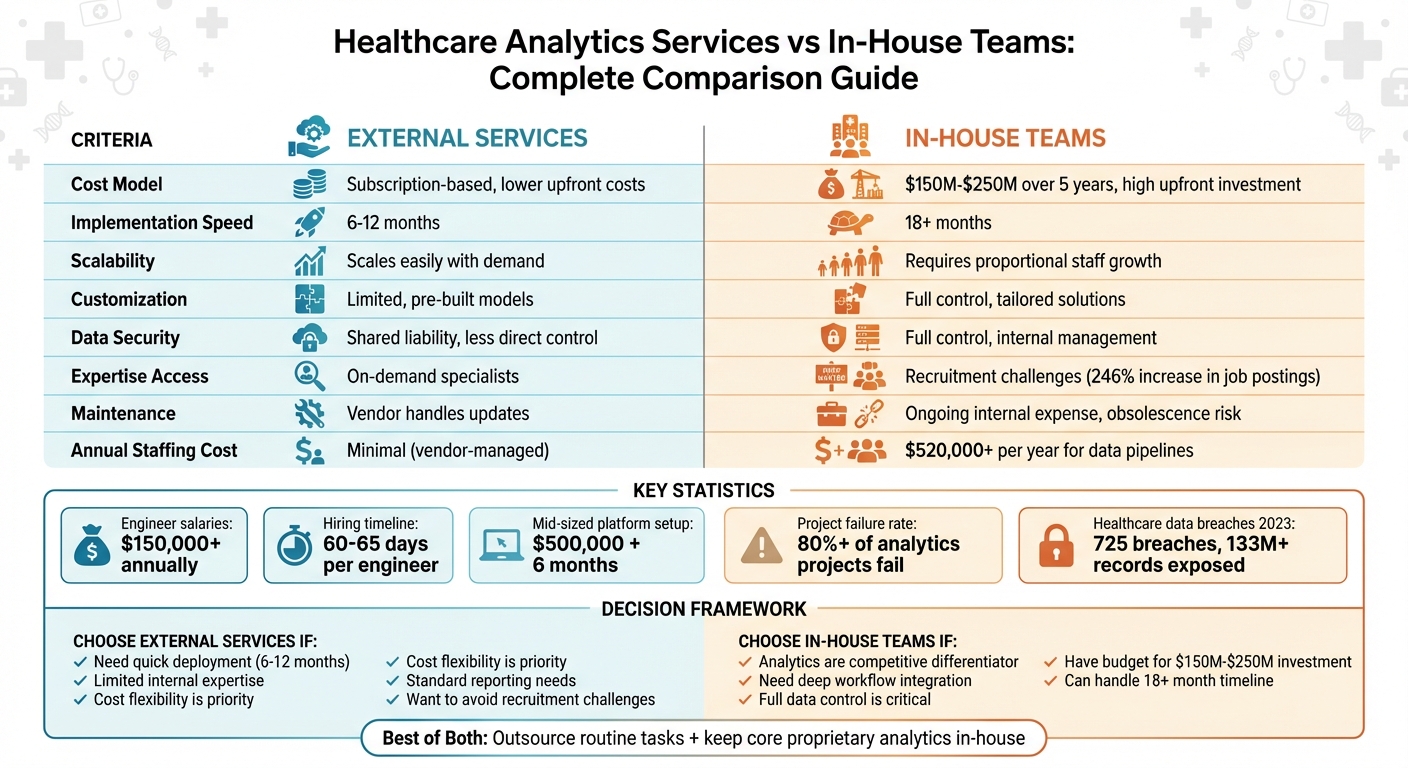
Healthcare Analytics: External Services vs In-House Teams Comparison
External healthcare analytics services provide tailored solutions to meet diverse organizational needs. Let's break down some of the key models they offer:
One of the standout features of these services is their ability to integrate different EMR systems, creating unified and accessible data histories. They also offer scalable data warehouses and business intelligence (BI) tools to help organizations manage their data more effectively. Another valuable tool is analytic accelerators, which can quickly organize complex data sets - like 70,000 ICD-10-CM codes - into manageable categories. This allows organizations to skip months of model-building and jump straight into actionable insights.
A critical feature of these services is benchmarking. They provide performance snapshots and comparisons with industry peers, insights that are often hard to achieve using internal data alone. Additionally, these platforms are designed to adapt quickly to changes in healthcare regulations and national reporting standards.
In 2023, Carle Health adopted Tech-Enabled Managed Services to boost their analytics capabilities. Phillip Rowell, the Chief Analytics Officer at Health Catalyst at the time, shared:
We chose Health Catalyst and TEMS to expedite our analytics capabilities and empower our workforce to advance in their careers.
This example shows how external services can help organizations quickly scale their analytics while also building internal expertise.
External services bring several practical advantages to the table. One of the most immediate benefits is access to specialized expertise. With job postings for data analysis professionals skyrocketing by 246%, many healthcare organizations face challenges in recruiting and retaining top talent. External services eliminate this hurdle by providing on-demand access to niche experts.
Another major benefit is faster implementation. These services often come with pre-built infrastructure and ready-to-use models, allowing organizations to see results in just weeks or months.
Cost flexibility is another advantage. Instead of committing to fixed expenses like salaries, infrastructure, and maintenance, organizations can opt for subscription-based pricing or pay for outcomes. This approach makes it easier to justify analytics investments, especially when the long-term benefits are still uncertain.
Scalability is a game-changer for many organizations. External providers can adjust their services to match your needs, whether you're scaling up or down. They also handle many routine tasks - like data preparation, hypothesis testing, and automated reporting - freeing up your team to focus on strategic goals. This is particularly helpful for organizations transitioning to value-based care models, which require integrated patient histories across multiple EMR systems.
Despite their advantages, external analytics services come with some limitations. One key drawback is limited customization. Most platforms offer standardized models and reporting structures, which may not align perfectly with your clinical workflows or operational goals. While some customization is possible, you're often working within the vendor's predefined framework.
Another concern is vendor dependency. Once you've integrated an external service into your operations, switching providers can be costly and disruptive. Intellectual property (IP) ownership is another potential issue - especially if the vendor undergoes a merger or acquisition. It's crucial to clarify IP rights before signing any contracts.
Data security concerns also come into play when sharing sensitive patient information with third-party vendors. Even with strong security measures and compliance certifications, some organizations remain uneasy about external access to their data. Additionally, clinicians often place more trust in internally validated data than in externally verified information.
Finally, there's the issue of "rear-view mirror" insights. External services are great at showing where your organization stands compared to peers, but they often lack the deeper context needed to guide actionable changes. As Health Catalyst puts it:
Relying on outsourced analytics consisting only of outcomes data is much like driving forward looking in the rear-view mirror.
This highlights the importance of maintaining internal expertise to interpret these insights and turn them into meaningful improvements.
Building an in-house analytics team means assembling a diverse group of professionals, including data scientists, engineers, analysts, architects, IT experts, and, when necessary, clinicians, pharmacists, and nurses. This team is tasked with addressing the organization’s ever-changing analytics needs. While external solutions often promise quicker deployment and benchmarking, in-house teams stand out by offering tailored integration and complete control over data.
The development of in-house analytics generally follows three stages: foundational reporting, advanced strategic analysis, and predictive modeling powered by machine learning and electronic medical record (EMR) data. This phased approach allows organizations to manage costs and build expertise gradually, avoiding the pitfalls of attempting too much at once. This methodical development paves the way for distinct advantages that external services typically cannot provide.
These teams must master a wide range of skills, including data visualization, EMR reporting, database modeling, quality metrics, regulatory compliance, clinical terminology, data mining, and advanced statistical modeling. Beyond technical expertise, team members need strong data literacy, critical thinking, and clinical informatics knowledge to ensure accurate interpretation of data in a healthcare setting.
The financial investment for an in-house analytics team is substantial. Maintaining a functional team can cost around $520,000 per year, just to manage data pipelines. Salaries reflect the specialized skills required: data engineers earn an average of $111,500 annually, while data analysts start at over $70,000. Setting up the infrastructure for a mid-sized analytics platform costs about $500,000 and can take over six months to implement. For larger healthcare systems, building proprietary analytics platforms may require an investment of $150 million to $250 million over five years.
Dr. David M. Wild, Vice President of Lean Promotion at The University of Kansas Health Center, highlights the operational impact of in-house teams:
The benefit of a data analytics team is that analysts will take data and, as quickly as possible, develop information from that data. They will then share what they've learned with operational leads who can translate that information into actionable insights.
The primary advantage of an in-house analytics team is having complete control over your data strategy and security. You determine what gets developed, when it happens, and how it integrates with your existing systems. There’s no reliance on a vendor’s framework or waiting for them to prioritize your requests.
Another key benefit is deep workflow integration. Internal teams build a thorough understanding of your clinical workflows, EMR systems, and organizational needs. This knowledge allows them to design custom solutions that align perfectly with your operations, from departmental processes to unique patient demographics.
Data trust is also enhanced. Clinicians and operational leaders are more likely to trust insights generated by colleagues they work with directly, which can lead to faster adoption of data-driven decisions.
In-house teams also reduce the time-value curve, meaning they can act on data faster. Analysts can quickly identify specific patient groups, monitor improvement efforts in real-time, and deliver actionable insights that drive immediate workflow changes.
Lastly, all institutional knowledge and intellectual property stay within your organization. Every model, insight, and improvement becomes a competitive edge that external vendors cannot replicate or acquire.
Despite their benefits, in-house teams come with challenges, starting with cost. The financial burden of salaries, infrastructure upgrades, software licenses, and training is significant. These are fixed costs, incurred regardless of whether your analytics initiatives succeed.
Recruitment and retention are ongoing hurdles. The competition for professionals with both technical expertise and healthcare knowledge is fierce. When team members leave, replacing them can be expensive and time-consuming, often leading to months of lost productivity.
Another drawback is the longer implementation timeline. Building infrastructure from scratch can take over six months, delaying results. Unlike external vendors with ready-made tools, in-house teams require significant time before delivering value, potentially missing urgent opportunities.
Skill gaps are common, especially in areas like predictive modeling or advanced machine learning. While your team might excel at operational reporting, they may lack the expertise for cutting-edge analytics. Filling these gaps often requires expensive hiring or training initiatives.
There’s also a risk of obsolescence. Long development cycles, sometimes spanning years, mean your system could become outdated before it’s even fully operational. Studies suggest that over 80% of data analytics projects fail to meet their goals due to factors like outdated technology, poor data quality, or misaligned business processes.
Finally, in-house teams often lack industry benchmarking capabilities. While they provide deep insights into your operations, they don’t offer the peer comparisons or performance metrics that external services do. This internal focus can lead to blind spots, where you might be improving but still lag behind industry standards without realizing it.
Managing analytics in-house can cost anywhere from $150 million to $250 million over five years as a capital expenditure, while external services operate on a subscription-based model with predictable operating expenses. Let’s break down the staffing and infrastructure costs that drive these two approaches.
Staffing is a significant factor in the cost gap. Healthcare analytics engineers earn base salaries starting at $150,000 annually, not including benefits or equity. On the other hand, specialized contractors charge between $175 and $210 per hour. Hiring a single engineer takes 60–65 days, and competition is fierce, especially with major tech companies vying for the same talent pool.
External services sidestep these challenges entirely. Vendors handle recruitment, retention, and training, freeing organizations from the burden of building and maintaining an in-house team. Anthony Del Rio, former Executive Director and President at Rush Health, highlighted this difficulty:
Building our own platform became increasingly more expensive because we weren't really scaling. Every time we wanted to add a new practice or add a new feature or template, it required new investments and new staff.
Creating an in-house platform often takes over 18 months, significantly delaying its benefits compared to external solutions, which can deliver value in 6–12 months. That time lag translates to missed opportunities for improving patient outcomes, cutting waste, and generating revenue through better analytics.
Here’s a side-by-side comparison of key cost categories:
| Cost Category | In-House (Build) | External Services (Buy) |
|---|---|---|
| Initial Investment | $150M–$250M over 5 years | Lower upfront; implementation fees |
| Staffing | $150,000+ per engineer, plus benefits | Minimal; vendor manages technical staff |
| Time to Value | 18+ months | 6–12 months |
| Infrastructure | High (cloud platforms, storage, tools) | Included in subscription |
| Maintenance | Ongoing internal expense; obsolescence risk | Vendor handles updates and compliance |
| Scalability | Requires proportional staff increases | Scales via existing vendor infrastructure |
Beyond direct expenses, in-house systems come with indirect costs. Teams must regularly update systems to meet regulatory requirements like HIPAA, manage multiple technology vendors, and spend 2–3 months training staff on new implementations. These ongoing maintenance efforts remain constant, regardless of the system's performance, while external services bundle these responsibilities into their subscription fees.
Additionally, building and maintaining an in-house system diverts IT and clinical teams from focusing on patient care. With non-clinical labor costs in healthcare projected to rise by $77 billion in 2024, every hour spent on system upkeep becomes an increasingly costly trade-off.
While large health systems may eventually recoup their investment in an in-house solution, their costs grow linearly as they expand. In contrast, external services provide economies of scale, enabling growth without proportional cost increases.
As your organization grows, your analytics infrastructure needs to grow with it. This is where the choice between external services and in-house teams becomes especially important, particularly when faced with fluctuating demand or rapid changes in regulatory requirements.
External providers offer instant access to advanced tools and skilled professionals, eliminating the lengthy timelines associated with building capabilities from scratch. For example, when data volumes surge or a new facility with a different electronic medical record (EMR) system comes online, external vendors can quickly adapt. They often rely on cloud-based platforms to handle the increased complexity and volume seamlessly.
Another advantage of outsourcing is the ability to turn fixed costs into variable ones. Instead of committing to permanent overhead, resources can be adjusted based on actual demand. One executive highlighted this benefit:
Investing in an in-house analytics team is always an attractive proposition but is expensive and difficult to convince management to fund without fully knowing the future benefits. Outsourcing is an easier way to get capabilities quickly and at a low cost.
External vendors achieve this scalability through streamlined processes and access to global talent pools that include data scientists, architects, and clinicians. This means they can respond to new challenges without delays.
Scaling in-house operations, on the other hand, often comes with significant hurdles. Hiring more staff is a common approach, but it can quickly become a bottleneck. The demand for data professionals is soaring - job postings for these roles have increased by 246%, making recruitment highly competitive. Even after hiring, onboarding and training new employees take time, further slowing the process.
Expanding internally also means higher costs. Each new location, data source, or regulatory update requires additional staffing and infrastructure investments.
There’s also the risk of falling behind. Developing a proprietary platform can take years, and by the time it’s ready, the technology or regulatory environment may have already evolved. To stay relevant, continuous training for the team is essential, adding to the ongoing costs and management responsibilities.
As analytics systems grow more complex, ensuring robust data security and compliance is non-negotiable - especially when handling sensitive patient information. In 2023 alone, the healthcare sector faced 725 data breaches, exposing over 133 million records. This stark reality underscores the importance of choosing between external services and in-house teams for managing data security.
External providers, operating as Business Associates under HIPAA, are legally obligated to secure electronic protected health information (ePHI) and report breaches promptly. These responsibilities are formalized through Business Associate Agreements (BAAs), which establish clear contractual and legal accountability independent of your organization.
On the other hand, in-house teams provide a different level of control. Since data stays within your organization, the risks tied to external transmission are significantly reduced. Jorie AI highlighted this advantage:
Internal management offers greater control over data security measures, minimizing risks associated with sensitive patient information.
With an in-house approach, your IT staff works under your direct oversight, giving you full authority over who can access data and when.
However, managing data security internally comes with its own challenges. In-house teams must conduct regular risk assessments, implement safeguards, and stay updated on ever-changing regulations. These tasks can be resource-intensive, whereas external providers often streamline such processes using advanced tools like AI-driven fraud detection and automated compliance monitoring. Many external vendors boast vulnerability patch compliance rates between 95% and 99%. Additionally, they employ dedicated compliance teams to track regulatory updates, ensuring immediate adjustments when changes occur, such as updates to ICD codes or Medicare fee schedules.
When shaping your analytics strategy, weigh the trade-offs: external providers bring specialized expertise and share liability through contractual agreements, while in-house teams offer unmatched control but require significant investment in infrastructure, training, and compliance management. Both options can meet HIPAA standards, so the right choice ultimately depends on your organization's resources and risk tolerance.
When you handle analytics in-house, you gain complete control over your infrastructure. This means full oversight of your data, from its origin to the final output. With this level of ownership, you can create tailored patient cohorts and unique data groupings that meet your organization's specific needs. Plus, having an internal team allows for quicker project iterations, ensuring your analytics tools adapt seamlessly to changing operations and priorities. This setup offers a stark contrast to relying on external vendors, where flexibility and control can be more limited.
External services, on the other hand, bring pre-built models to the table. These include widely accepted frameworks, such as disease severity or comorbidity groupings, which organize around 70,000 ICD-10-CM codes into simpler categories. This can significantly speed up the development of custom models, saving time and effort. As Nidhi Thakkar, an Analytics Consultant at Merative, explains:
Licensing foundational analytic models to build upon can accelerate time to market and allow internal teams to focus on creating products and offerings that impact the bottom line.
However, outsourcing comes with trade-offs. One major drawback is reduced visibility into the data processes, which can make it harder to identify and fix errors. Additionally, relying on a vendor means your organization may have to align with their roadmap for system updates, potentially limiting your flexibility. Clinicians, for instance, often trust data more when it’s validated by their internal, cross-functional teams.
Finding the right balance between control and flexibility is crucial when crafting an analytics strategy. External services often allow some customization - such as tweaking risk algorithms, quality measures, or dashboard reporting - to better fit your workflows. Modern platforms are also designed to provide out-of-the-box functionality while remaining adaptable for internal teams to use data in unique ways. Many organizations now embrace a hybrid model: they rely on external vendors for routine reporting but keep high-value, proprietary analytics in-house to maintain a competitive edge.
The real challenge lies in determining which analytics are critical to your organization’s success and should be managed internally, versus those that can be efficiently outsourced. It’s also essential to assess whether an external platform can be configured to align with your operational goals. While developing proprietary analytics often requires a significant investment, the "build and buy" hybrid approach is becoming an increasingly practical solution for many organizations.
Deciding between external analytics services and building an in-house team depends on where your organization stands today and what it aims to achieve in the future. If you're starting from scratch or lack strong expertise in data analysis, external services can offer a quicker route to get up and running. This speed can be crucial when you're under pressure to meet value-based care requirements or adapt to shifting regulatory demands. But before jumping in, take a close look at the financial implications of each choice.
Budget plays a huge role. Developing your own analytics platform demands a significant upfront investment and ongoing staffing costs. Unless analytics are central to your competitive edge, this kind of spending might not make sense for most organizations.
Your strategic goals are another key factor. If your analytics deliver unique, market-differentiating insights, keeping them in-house helps protect your intellectual property. On the other hand, if your needs revolve around standard reporting or widely available metrics like population health data, outsourcing may be the smarter, more cost-effective choice. Aligning your analytics approach with your organization's competitive strategy ensures you're investing in the right areas.
Many organizations are also turning to a hybrid model. For example, you can license foundational tools - such as disease severity groupings for the 70,000+ ICD-10-CM codes - from external vendors. This allows your team to focus on creating proprietary analytics that directly impact your bottom line, rather than spending time and resources on building basic infrastructure. Before committing to any external partnership, make sure to clarify ownership of any insights or algorithms developed during the collaboration to protect your strategic assets.
To make the best decision, start with an honest evaluation of your organization's current capabilities. Can your team handle regulatory changes within tight deadlines, like 30 days? Do you have enough data to generate meaningful, unique insights? And how does the opportunity cost of waiting for an in-house solution compare to the faster implementation of an external service? These questions, along with earlier considerations like cost, scalability, and control, will help you choose the path that aligns best with your organization's needs, budget, and strategic goals.
External healthcare analytics services come with a range of benefits that often outshine the capabilities of in-house teams.
First, they help cut costs by removing the need to recruit, train, and retain specialized staff or invest in pricey infrastructure like data warehouses. This makes them an efficient option for healthcare organizations aiming to make the most of their budgets.
Second, these services offer unmatched flexibility. They can scale up or down quickly to meet changing needs, whether it's for a new project or seasonal workload spikes. In comparison, in-house teams are constrained by fixed salaries and a limited number of staff.
Third, external providers give you instant access to cutting-edge tools and specialized expertise, like AI-powered predictive models and benchmarking insights. Building these capabilities internally could take years. On top of that, many external partners take care of crucial tasks like regulatory compliance, data security, and system updates. This not only keeps your analytics secure and current but also eases the workload on your internal teams.
External healthcare analytics services come with the advantage of lower upfront costs, as they usually operate on a subscription or service-fee model. This setup removes the need for hefty investments in infrastructure, software licenses, or hiring specialized staff. Another key benefit is speed - these services are often pre-built and ready for quick customization, meaning organizations can start seeing results in just weeks or a few months.
In contrast, building an in-house analytics team demands a significant initial investment. You'll need to allocate funds for servers, software, and the recruitment or training of skilled professionals like data engineers and analysts. Beyond the financial commitment, the process of designing and implementing an internal system can take several months to a year before delivering actionable insights. While this route may provide greater control over the long term, the higher upfront costs and slower timeline are critical factors to weigh.
When weighing the choice between external analytics services and building an in-house team, healthcare organizations need to evaluate factors like speed, cost, expertise, scalability, and long-term adaptability.
External services often deliver results more quickly because they come equipped with the necessary tools and skilled professionals. On the other hand, creating an in-house team takes time, as it involves recruiting staff, training them, and setting up the required infrastructure. When it comes to cost, external services usually operate on a subscription model, while in-house teams demand a significant upfront investment in hardware, software, and employee salaries.
Expertise is another critical point. External providers bring seasoned analysts and access to benchmarking data, but they might not have the same understanding of your organization’s unique needs that an internal team can develop over time. Scalability is also worth considering - external vendors can manage infrastructure expansion seamlessly, whereas in-house teams need careful planning to handle growth. Lastly, it’s essential to evaluate how well your choice aligns with your strategic goals and budget in the long run.