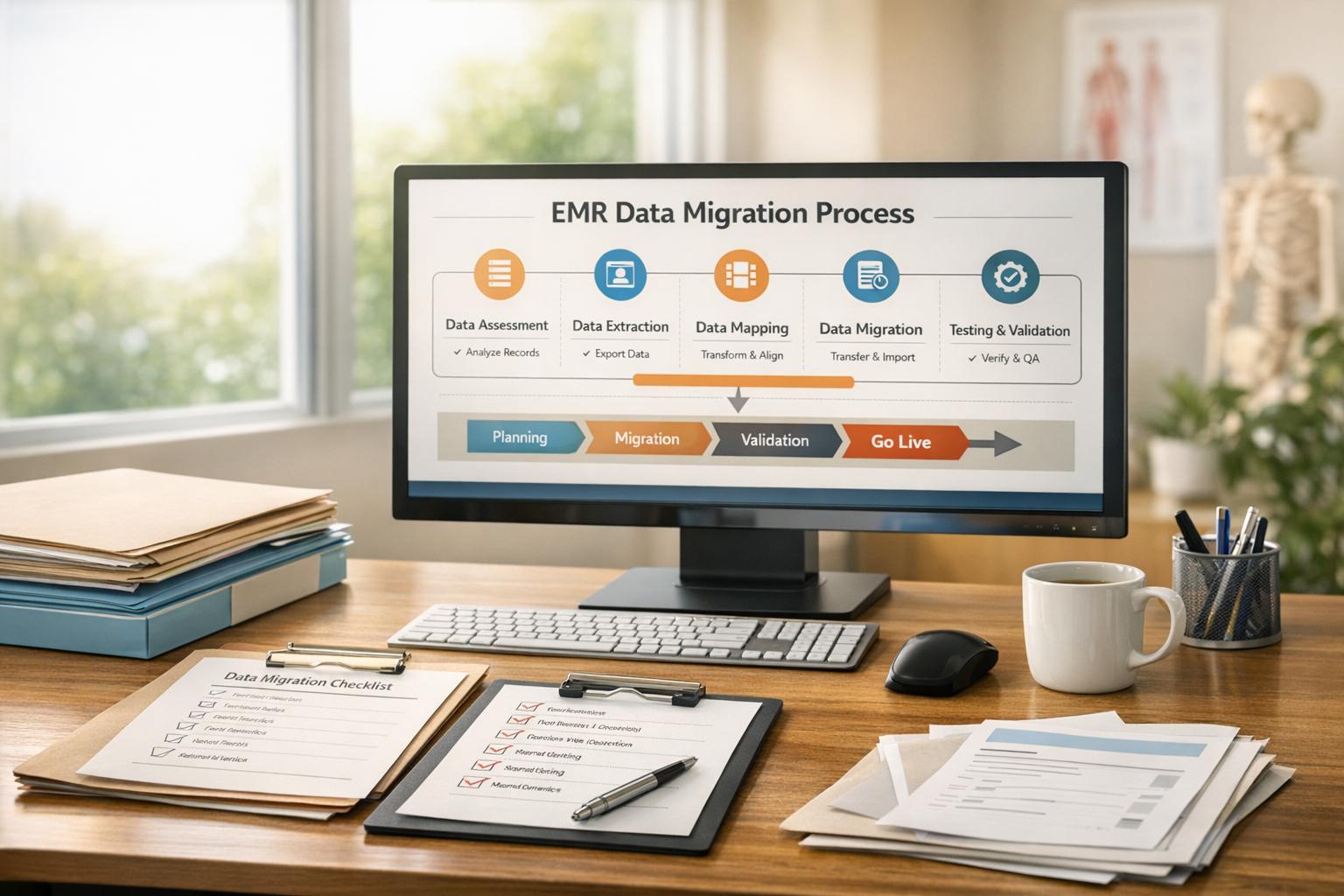
Overview of claims data layers, denial reduction, AI automation, EHR integration, and HIPAA practices to cut denials and improve revenue cycle.
Healthcare claims data is the backbone of financial and operational decisions in healthcare. It includes patient demographics, diagnosis codes, procedure details, and financial information. Mismanaging this data can lead to costly errors, delays, and revenue loss. Here's what you need to know:
Quick takeaway: Clean claims data ensures faster reimbursements, fewer denials, and better financial outcomes. Using AI tools, integrated systems, and strong data governance can transform claims management and protect revenue.
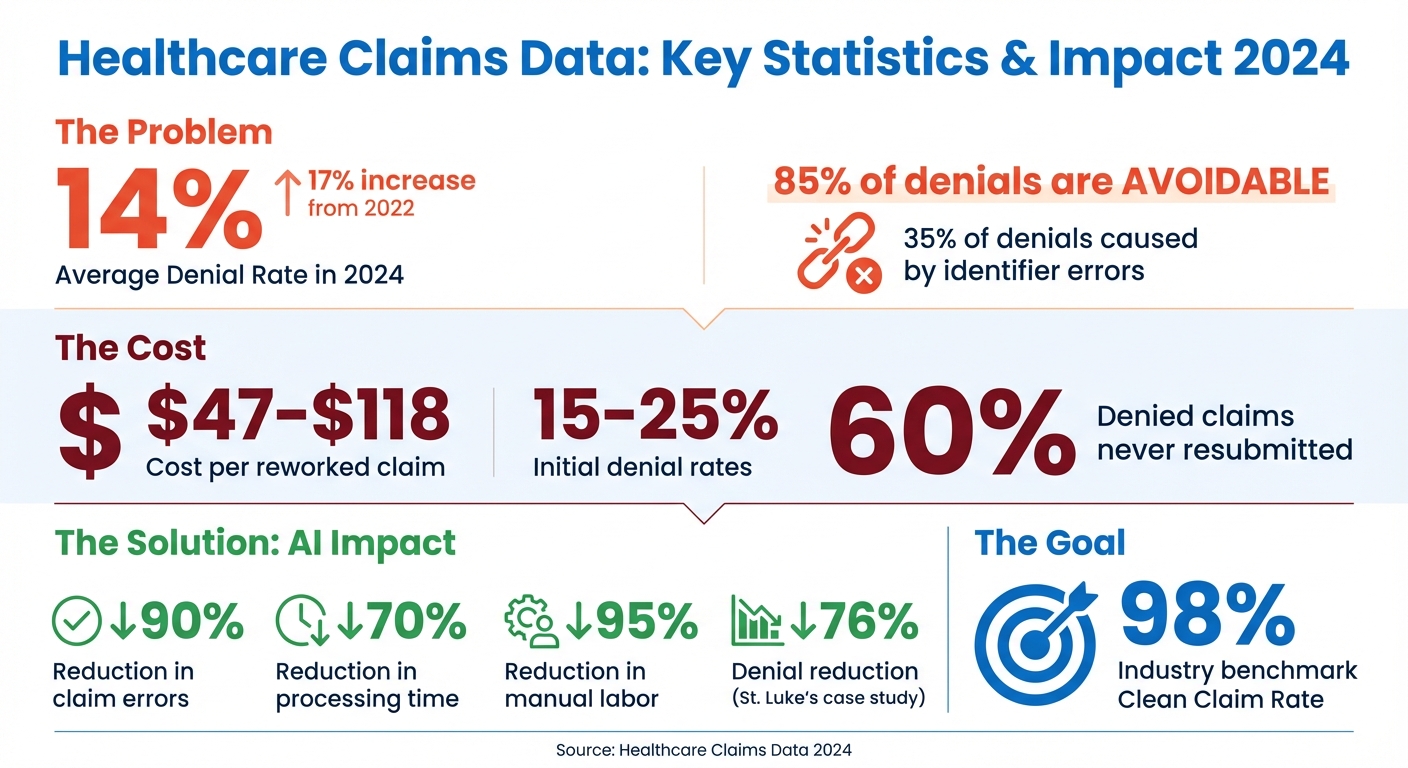
Healthcare Claims Data Statistics: Denial Rates, Costs, and AI Impact 2024
Healthcare claims are built on three main layers of information, each playing a crucial role in determining whether your organization gets reimbursed on time. By understanding these layers, managers can spot and fix errors before they lead to costly denials. Let’s break down each layer to see how they work and how to avoid common pitfalls.
Think of the claim header as the "cover page" of your payment request. It summarizes key details like patient demographics (date of birth, gender, zip code), the National Provider Identifier (NPI) for both the attending physician and the facility, the primary diagnosis code that justifies the visit, insurance information, and the total charges for the claim.
Payers always start by reviewing the header to decide whether to approve or reject the claim. As Jordan Levitt, Senior Vice President at Experian Health, explains:
"Once you let bad data in the door, it's like a virus. Every action you take once bad data enters your system is wasting resources".
Here’s a real-world example: In August 2025, Exact Sciences introduced automated checks for patient demographics and insurance details during intake. This change cut claim denials in half and added $100 million to their revenue within six months. To achieve similar results, verify header data during registration and use clearinghouses to clean and standardize this information according to each payer’s specific requirements before submitting claims.
Next, let’s dive into the line-item details that back up the claim.
While the header gives an overview, line items provide the nitty-gritty details about each service rendered. Every service is listed with its procedure code (CPT or HCPCS), service date, billed amount, number of units, and any modifiers that clarify the context - like whether a procedure was done on both sides of the body or was discontinued.
Payers rely on this information to calculate the exact reimbursement amount. To avoid issues, make sure each procedure code matches the associated diagnosis code to justify medical necessity. Be mindful of billing rules, such as those limiting some descriptors (like "per day") to a single unit, even if multiple services were provided.
For example, Schneck Medical Center used the AI Advantage system to predict claim outcomes and catch line-item errors before submission. This proactive strategy led to a 4.6% average monthly drop in denials. To replicate this success, use scrubber software to flag mismatched NPIs, incorrect units, or formatting errors. When manually entering ICD-10 codes, leave out decimal points and special characters. For date formats, stick to one standard - either six-digit (MMDDYY) or eight-digit (MMDDCCYY) - and use it consistently.
Now, let’s look at the identifiers that tie everything together.
Accurate identifiers are the backbone of a successful claim. Patient identifiers - like name, date of birth, gender, and insurance ID - confirm eligibility and determine co-pays and deductibles. Provider identifiers, such as the NPI for individuals and facilities and the Tax ID, ensure that the correct provider gets credited and help track referral patterns.
Errors or omissions in these identifiers are responsible for 35% of claim denials. To avoid this, verify insurance and demographic information during registration. Use integrated systems that connect your Electronic Health Records with Revenue Cycle Management platforms, creating a single source of truth for patient and provider data.
Tracking your clean claim rate, particularly for identification errors, can highlight whether your team needs additional training or if system updates are necessary to stop bad data from entering the revenue cycle.
Understanding claims data isn't just about numbers - it's about spotting inefficiencies, cutting down errors, and speeding up reimbursements. In 2024, denial rates have climbed to an average of 14%, marking a 17% increase from 2022. Even more concerning, 85% of these denials could have been avoided. This represents a massive financial strain on the U.S. healthcare system, but it also highlights an opportunity for improvement.
By focusing on three critical areas - claims scrubbing, denial management, and system integration - managers can significantly reduce losses and free up staff for more meaningful work. These strategies can refine the entire claims process, making it smoother and more efficient.
Automated scrubbing tools are like a safety net for your claims process, catching errors before they even reach the payer. These tools validate everything from patient demographics and eligibility to coding accuracy (ensuring ICD-10 and CPT codes align), compliance with regulations (like NCCI edits), payer-specific requirements, and overall data integrity.
The difference between manual and automated scrubbing is night and day. Manual processes are prone to mistakes and simply can't keep up with high claim volumes. Automated tools, on the other hand, can handle large workloads, identify errors quickly, and provide real-time feedback that manual reviews can't match.
Top-performing organizations aim for a Clean Claim Rate (CCR) of 98%. To hit this target, start by implementing front-end edits during patient intake. This step ensures bad data doesn't enter the system in the first place. Additionally, integrate charge scrubbers with your EHR to audit billing data at the point of care, catching issues before the claim is even compiled.
Instead of tackling denials one at a time, use claims data analytics to uncover patterns across your portfolio. Group denials by payer, procedure code, or root cause - such as missing prior authorizations or documentation errors - and focus on fixing the root issues.
This broader approach helps address systemic problems rather than just isolated cases. For example, if a particular payer frequently denies claims for a specific procedure, you can dig deeper to determine if it's due to documentation gaps, coding errors, or a misunderstanding in the contract terms. Use this data to your advantage during contract negotiations, grading payers based on their denial rates and reimbursement timelines.
Automation can also simplify status checks, replacing the tedious process of logging into payer portals or making phone calls. API technology can pull detailed claim statuses - down to service-line adjustments - within 24 to 72 hours. You can even configure your system to automatically flag invoices in aging queues, allowing staff to focus only on claims that need manual attention.
When deciding which denials to appeal, AI tools can help prioritize by value. Focus your team's efforts on high-dollar claims with the best chances of reimbursement. Keep in mind that 60% of denied claims are never resubmitted. With better workflows, you can recover much of this lost revenue.
This systematic approach, when combined with strong data validation practices, creates a solid claims management framework. Integrating these tools with your EHR and billing systems further enhances accuracy and streamlines operations.
Integration is a game-changer, eliminating the manual data entry that often leads to claim errors. When your EHR automatically populates billing fields with clinical data, transcription mistakes are minimized, and you maintain a detailed audit trail for compliance.
API-driven tools take it a step further by connecting directly to clearinghouses. These solutions pull real-time updates from hundreds of payers into your system, normalizing data into a single, easy-to-read format. This means your staff can quickly interpret claim statuses and denials without juggling multiple platforms.
But integration isn’t just about reducing errors - it also provides valuable insights. For instance, visual analytics can track referral patterns to identify "network leakage", where patients are referred out-of-network. This data can help you improve patient navigation, expand your services, or address gaps in your provider network.
To get the most out of integration, assign a dedicated team or individual to monitor claims analytics. They can spot long-term trends in payer behavior or coding errors, ensuring that even with automation, emerging issues are caught early. Human oversight remains essential for keeping operations running smoothly and addressing problems before they grow.
AI tools are transforming claims management by making processes faster and more precise. Instead of depending on manual reviews and spreadsheets, these intelligent systems can verify insurance eligibility instantly, catch errors before claims are submitted, and extract useful insights from massive datasets.
MedOps simplifies insurance verification by automating the process of checking patient coverage details, co-pays, deductibles, and pre-authorization requirements during registration. This real-time system cross-references registration data with payer databases, flagging potential issues that might lead to claim denials.
The platform also identifies common billing errors, such as missing modifiers, incorrect diagnosis codes, or mismatched provider information. Keith Favreau, Director of Product at WebPT, shared the impact of these tools:
"We increased revenue by decreasing billing errors and by speeding up patient charting by 25%".
MedOps goes a step further by validating claim details like provider taxonomy, NPI numbers, and ZIP+4 codes against master files before submission. This proactive approach helps avoid technical denials that can delay payments. Seamlessly integrating with your EHR system, MedOps enables automated insurance verification and error detection right at the point of care. These checks not only improve claim accuracy but also set the stage for powerful claims analytics.
AI-powered claims analytics turn raw data into actionable insights. By analyzing data in real time, these systems can uncover payer-related issues, procedural inconsistencies, and documentation gaps, helping managers address problems before they escalate. For instance, organizations can evaluate insurers based on their "hassle factor", which measures how often they deny claims or request additional documentation - valuable information for contract negotiations.
Healthcare providers using AI verification and analytics tools report major improvements, including lower denial rates and better revenue capture. Visual analytics tools further enhance decision-making by presenting complex datasets in interactive dashboards. A compelling example comes from New York-Presbyterian Weill Cornell Medical Center in 2023. Using visual analytics, they identified 6,399 congestive heart failure patients - the highest number in the U.S. - and pinpointed 64 referrals that were leaking to out-of-network Tisch Hospital. This insight allowed them to target network optimizations effectively.
Modern API-driven solutions also streamline the claims process by providing real-time updates from multiple payers. These tools eliminate the need for manual status checks and offer full transparency into each claim, including allowed amounts, adjustment reasons, and coinsurance details. With nearly 80% of healthcare executives increasing IT budgets to adopt AI-based tools, leveraging these advanced analytics is becoming essential for staying competitive in the healthcare industry.
Handling healthcare claims data demands strict adherence to federal laws and internal quality standards. A well-structured governance framework not only safeguards patient privacy but also ensures the precision required for seamless claims processing. This foundation is critical for maintaining HIPAA compliance and creating thorough audit trails.
HIPAA’s Privacy Rule allows covered entities to use Protected Health Information (PHI) for payment-related activities - such as claims adjudication, billing, and utilization reviews - without needing explicit patient consent. However, this comes with strict obligations. Organizations must implement three key layers of safeguards:
The Minimum Necessary Standard enforces limiting PHI access to only the information required for specific tasks. For example, claims processors should only access relevant patient records rather than full medical histories. Violations of these rules can lead to financial penalties ranging from $100 per incident to millions of dollars annually, making compliance a non-negotiable priority.
Any third-party vendor working with claims data - like clearinghouses or AI verification tools - must sign a Business Associate Agreement (BAA). Additionally, HIPAA compliance documentation, including risk assessments, training logs, and audit records, must be kept for at least six years. New employees handling claims data are generally required to complete HIPAA training within 30 days of their start date. These practices form the backbone of a secure and efficient claims processing system.
Accurate claims data begins with consistent internal processing rules. Since providers and insurers often submit and store data differently, organizations should establish standards to transform raw claims into uniform, analysis-ready formats. For example, the University of Wisconsin-Madison’s Health Innovation Program (HIP) Claims Data Processing Standards Toolkit offers detailed guidelines for merging claims from multiple sources while maintaining consistency.
Technical safeguards must log all activities in systems managing electronic PHI (ePHI) to ensure accountability. These audit trails document who accessed the data, when they accessed it, and any changes made. Visual analytics tools can help managers spot patterns and identify irregularities, such as "network leakage", where patients receive care outside expected provider networks. When using claims data for research or public reporting, ensure it is properly de-identified in line with HIPAA guidelines.
Assign a technical lead or team to oversee data quality initiatives. Document the processes and current performance metrics in detail. This thorough record-keeping not only supports internal audits and external regulatory reviews but also helps uncover gaps between current practices and established benchmarks.
Building on the importance of claims data integrity, streamlining workflows with automation can protect revenue while minimizing errors. Transitioning from manual claims processing to AI-driven systems starts with evaluating your current processes and identifying where technology can make the biggest difference. Automation not only reduces administrative tasks but also speeds up revenue cycles by eliminating the need for manual corrections.
The contrast between manual and AI-powered claims processing is striking at every stage of the workflow. Manual filing typically involves paper-based forms, which are prone to errors. In comparison, AI-powered digital forms can validate information in real-time, catching mistakes as they happen. Manual submissions often require reformatting data, increasing the likelihood of errors, while AI systems standardize inputs and flag issues before submission.
These differences have a direct financial impact. Reworking denied claims costs between $47 and $118 per claim, with initial denial rates ranging from 15% to 25%, quickly driving up expenses. AI tools, however, can cut claim errors by up to 90%, reduce processing time by 70%, and lower manual labor by 95%. For instance, in 2025, a major U.S. healthcare revenue cycle management provider partnered with Nalashaa to use robotic process automation (RPA) for claims status checks. The results were impressive: a 70% reduction in processing time and a 95% decrease in manual effort.
Real-world examples further highlight the benefits of automation. St. Luke's Health System, for instance, reduced claim denials by 76% after adopting Enhanced Claim Status technology.
To maximize efficiency, consider a hybrid approach: let AI handle routine tasks while reserving human expertise for complex, judgment-based cases. Start small by automating one process, such as status checks, to evaluate performance before scaling up. Continuously track key metrics like denial rates, clean claim rates, and days in accounts receivable to fine-tune your automation strategy.
Gaining a strong grasp of claims data fundamentals provides healthcare managers with a crucial advantage in navigating today’s intricate reimbursement systems. Knowing how to differentiate between claim headers and line-item details, adopting proactive scrubbing techniques, and ensuring HIPAA-compliant workflows lay the groundwork for a more efficient and reliable revenue cycle.
Taking these practices a step further, integrating AI automation can revolutionize operations. Many organizations that have implemented AI-powered verification at the intake stage report noticeable improvements, often within just six months. As Jordan Levitt, Senior Vice President at Experian Health, aptly puts it:
"Once you let bad data in the door, it's like a virus. Every action you take once bad data enters your system is wasting resources".
MedOps offers AI-driven tools designed to tackle these challenges head-on. With real-time verification, automated error detection, and streamlined integration, these solutions catch errors at the point of entry and standardize data before claims are submitted. This approach helps healthcare organizations work toward the industry benchmark of a 98% clean claim rate, complementing the claims management strategies discussed earlier.
As healthcare organizations adopt these advanced tools, it’s equally important to maintain strong data governance. Assigning a dedicated team to oversee analytics, ensure compliance, and update staff training is essential. Regularly tracking metrics like denial rates, days in accounts receivable, and clean claim percentages can provide critical insights, highlight areas for improvement, and measure success.
AI has the potential to drastically reduce claim denial rates by catching coding mistakes and documentation gaps before claims are submitted. It can conduct real-time eligibility checks and ensure that prior authorizations are properly handled, which lowers the chances of rejections. Additionally, AI leverages predictive analytics to spot high-risk claims, giving managers the opportunity to address potential issues ahead of time. By automating these processes, AI not only simplifies workflows but also reduces manual errors and boosts efficiency in managing claims.
To maintain HIPAA compliance when handling healthcare claims data, begin with a thorough risk assessment. Pinpoint where protected health information (PHI) is stored, how it’s transmitted, and any potential weak points. Use the findings to create detailed policies that cover administrative, physical, and technical safeguards. For instance, require all vendors managing claims data to sign a Business Associate Agreement (BAA) and enforce encryption for data both at rest and during transit. Restrict access based on job roles, keep detailed audit logs, and actively monitor for unauthorized access.
Educate your team on HIPAA’s Privacy and Security Rules, emphasizing the correct handling and disclosure of PHI for treatment, payment, and healthcare operations. Keep records of your policies, training sessions, and incident response plans, and update them regularly to reflect any changes. If a breach occurs, follow the official notification process, which includes alerting impacted individuals and the Department of Health and Human Services (HHS).
Incorporate compliance into everyday operations by using tools like automated claim validation, encrypted data transfers, and monitoring dashboards to track policy adherence. Regularly revisit your processes and provide ongoing support to safeguard patient information and maintain compliance over time.
Integrating electronic health records (EHR) with billing systems simplifies claims management by ensuring a smooth and accurate transfer of critical data. Details such as procedure codes, diagnoses, and patient eligibility are automatically synced, cutting down on manual data entry and reducing the risk of errors. This leads to more accurate claims, faster processing times, and a higher likelihood of approval on the first submission.
Another key benefit of this integration is the ability to perform real-time eligibility checks and automated code validation. These features significantly lower the chances of claim denials and rejections. On top of that, advanced analytics and AI-driven tools can spot inconsistencies, apply payer-specific rules, and speed up the reimbursement process. By bringing everything into one unified system, healthcare organizations can boost cash flow, improve operational insights, and make smarter decisions - all while creating a smoother experience for patients.