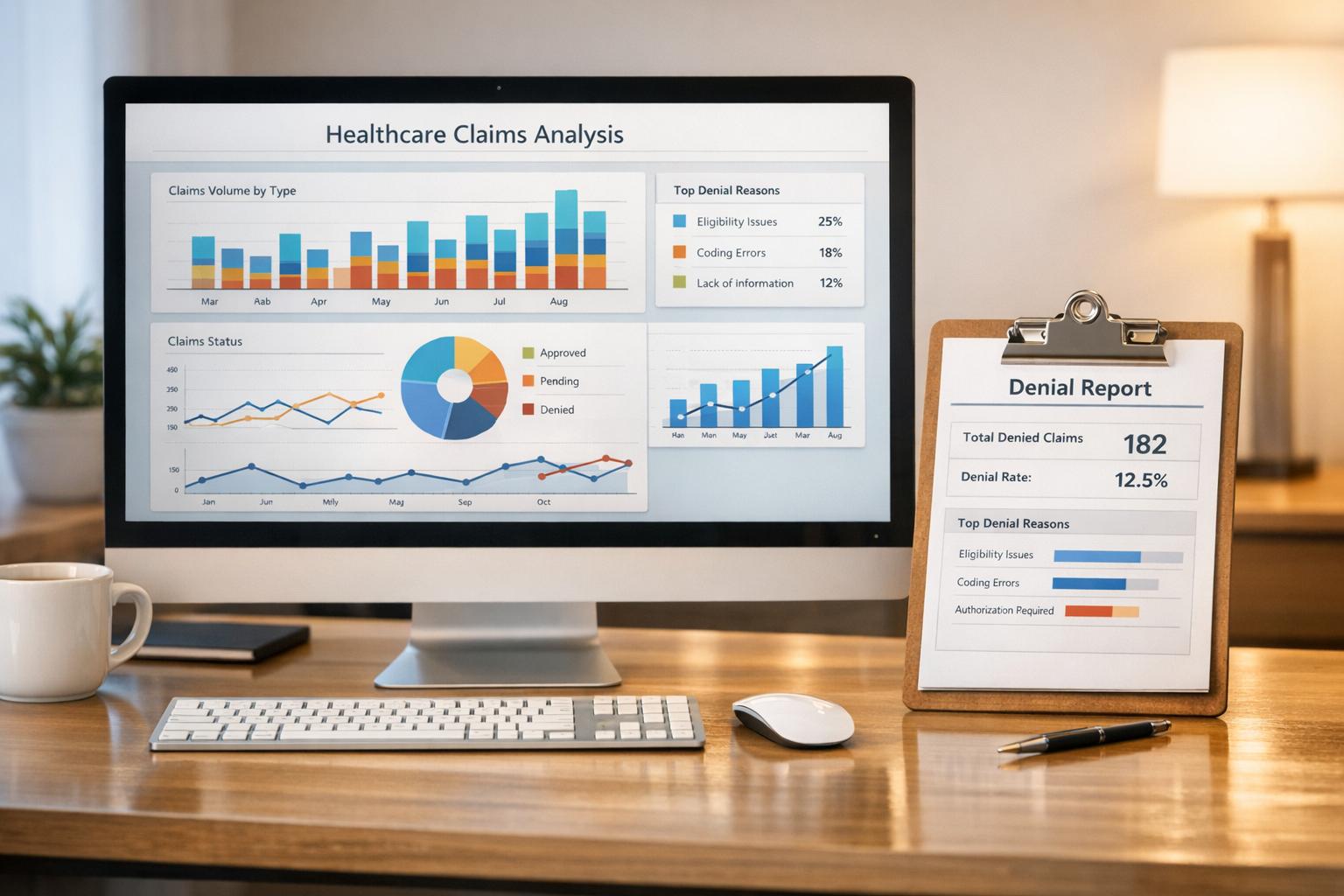
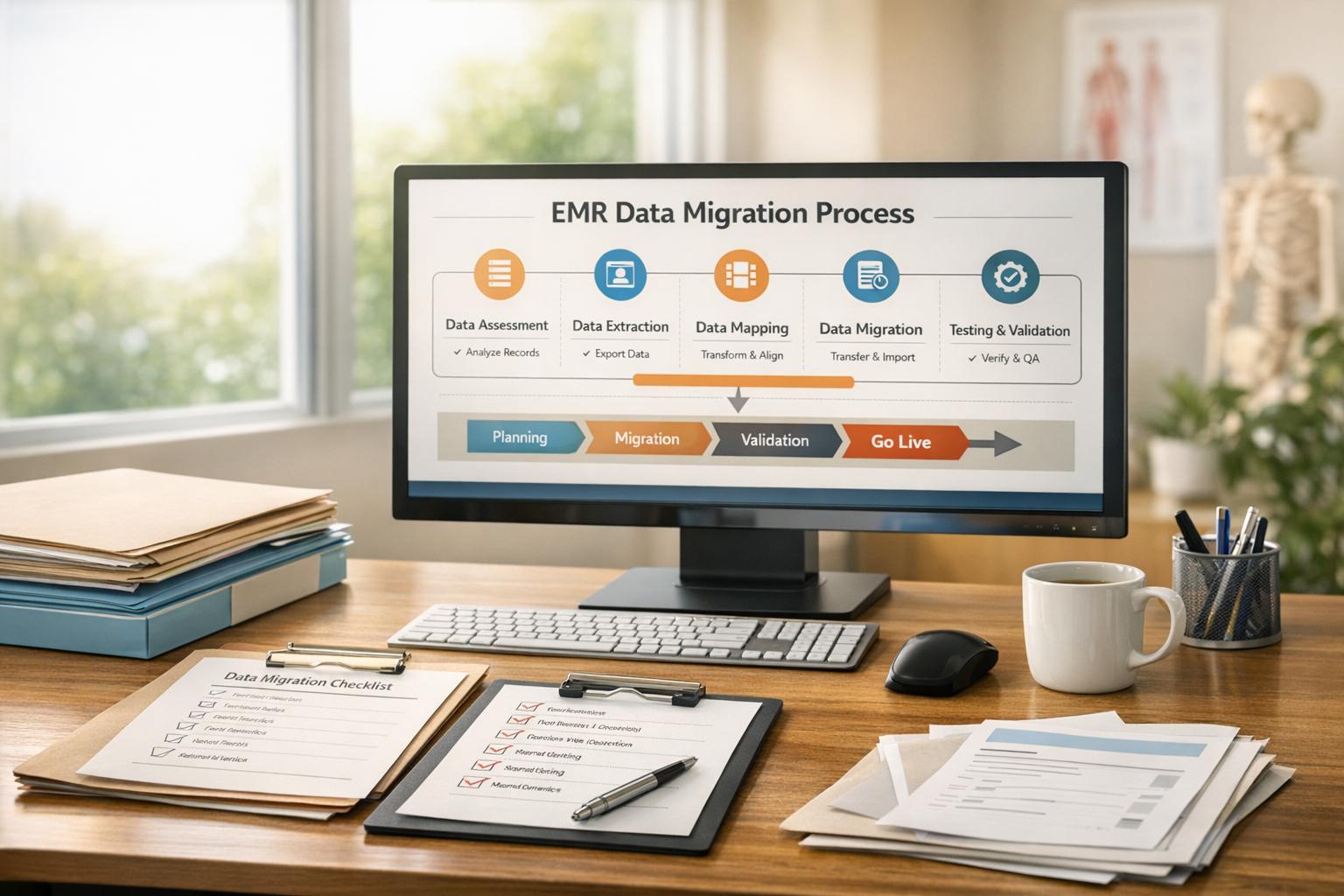
Analytics and AI that cut costs, improve patient outcomes, and streamline operations through real-time dashboards, integration, and strong data governance.
Healthcare data analytics transforms how healthcare organizations make decisions, improving patient care, reducing costs, and optimizing operations. By combining clinical, financial, and operational data, these solutions offer actionable insights that address challenges like resource allocation, regulatory compliance, and patient risk prediction.

Healthcare Data Analytics ROI: Cost Savings and Performance Metrics
Healthcare data analytics brings measurable advancements in three key areas: financial performance, regulatory compliance, and patient care quality. These aren’t just theoretical perks - they translate into real-world cost savings and operational improvements. By leveraging analytics, healthcare providers can transform their operations in profound ways.
Analytics has a knack for uncovering inefficiencies that drive up costs. Predictive modeling, for instance, revolutionizes how hospitals manage staffing and bed allocation. By forecasting patient admissions, discharges, and occupancy rates with precision, facilities can make smarter decisions. A great example is Seattle Children's Hospital and their FutureFlowRx model. This tool updates hourly to predict needs with remarkable accuracy, virtually eliminating surgical cancellations due to ICU bed shortages and cutting missed opportunities by 40%.
The financial results are equally impressive. Seattle Children's optimized its ENT surgical scheduling, leading to a net increase of five cases per block and generating an estimated $8.7 million in additional revenue. They also streamlined operations by consolidating over 1,000 redundant reports into a centralized data mart, slashing administrative costs and ensuring consistent data accuracy. Supply chain analytics further trims expenses by analyzing actual usage patterns, enabling smarter procurement decisions and reducing waste.
Cost savings go hand-in-hand with meeting strict regulatory requirements. Analytics solutions provide the robust infrastructure needed to comply with HIPAA standards and maintain eligibility for reimbursements. These systems ensure secure data handling through encryption, data minimization, and controlled access protocols. Standardized reporting tools also help organizations align their data collection, storage, and retrieval processes with regulatory guidelines.
Seattle Children's stands out here too - they achieved Stage 7 on the HIMSS Analytics Adoption Model for Analytics Maturity (AMAM), a level reached by less than 3% of surveyed organizations. For healthcare providers, integrating analytics with EHR systems is critical to demonstrating "meaningful use" and securing Medicaid and Medicare reimbursements.
Predictive analytics is changing the game by shifting care from reactive to proactive. By analyzing EHR data - such as demographics, lab results, medications, and past utilization - these tools can identify at-risk patients before complications arise. Advocate Health Care is a standout example. They developed an automated readmission risk tool using data from 126,479 patients across eight hospitals. Their "ACC Discharge Model" achieved a C-statistic of 0.78, outperforming their older manual method, which scored 0.69.
Real-time bedside monitoring takes this a step further. These systems use predictive models to generate immediate risk scores for conditions like renal failure, heart failure, and discharge readiness, allowing clinicians to act quickly. Additionally, self-service analytics empowers healthcare teams to test and implement quality improvement measures. For instance, Seattle Children's opioid-sparing protocol reduced postoperative morphine use, showcasing how analytics can directly enhance patient care.
MedOps tackles the heavy administrative load that makes up 25% of U.S. healthcare costs - roughly $1 trillion annually. Their AI-powered platform works to fix inefficiencies throughout the patient experience, from eligibility checks to revenue cycle management. By leveraging automation and analytics, the platform could help trim $200 billion to $360 billion in yearly healthcare spending in the U.S.. These tools bring the benefits of analytics into every corner of healthcare operations.
Insurance verification is often a bottleneck in healthcare, but MedOps automates this process right at registration, cutting out manual delays. Using AI, the platform checks insurance eligibility based on payer policies and contracts, flags duplicate patient records, and coordinates prior authorizations with insurance companies - all in real time. This streamlined validation reduces the errors that often slow down front-desk workflows.
The stakes here are massive. Around 60% of denied insurance claims go unchallenged, resulting in lost revenue that automation could help recover. Dr. Sanjiv Baxi, MD, Partner at McKinsey, highlights the impact:
"Toward the beginning of the patient journey, gen AI could help identify duplicate patient records, automate eligibility determination based on payer policies and contracts, coordinate prior authorizations from health insurance companies, and even propose solutions to address any administrative gaps identified".
Beyond insurance verification, MedOps offers tailored automation solutions to handle repetitive tasks like claims processing, clinical documentation, and bill adjudication. By automating these workflows, healthcare staff can shift their focus from paperwork to patient care. Thanks to no-code automation tools, healthcare teams can set up processes - like aggregating patient data or generating compliance reports - without needing technical know-how.
The productivity boost is tangible. Generative AI has been shown to increase call center efficiency by 15%–30%. Logan Masta, Director of Special Projects at Arcadia, emphasizes this benefit:
"AI frees up staff time by automating time-consuming administrative tasks, such as claims processing and clinical documentation".
MedOps also integrates directly with Electronic Medical Records, enabling healthcare teams to access and act on analytics within the same system.
MedOps provides real-time dashboards that give healthcare facilities centralized visibility into their operations. These dashboards track key performance indicators (KPIs) and offer guided drill paths for immediate action. With a role-based design, users can quickly access the specific data they need to address pressing issues.
The impact of real-time monitoring is striking. CHI-Franciscan in Washington State used an AI-enabled Mission Control Center between July 2019 and June 2020, deploying 12 real-time data tiles. The results? A 54% reduction in patient boarding and an impressive program ROI of 12:1. Their "Physician on Duty" program, supported by these dashboards, intervened in 142 critical patient safety cases and reduced lost cases by 20% within just six months. These tools not only enhance operational efficiency but also contribute to better patient outcomes by integrating seamlessly with broader analytics strategies.
Analytics tools are only as effective as their ability to seamlessly connect with existing systems while safeguarding patient data. Healthcare organizations face a dual challenge: making data accessible across platforms while adhering to strict security protocols. A well-executed integration strategy transforms scattered data into actionable insights, all while ensuring compliance. This integration serves as the foundation for secure and compliant analytics operations.
Modern healthcare analytics rely on the smooth exchange of data between electronic medical records (EMRs) and analytics platforms. HL7 FHIR (Fast Healthcare Interoperability Resources) R4 has become the go-to standard for real-time data exchange, replacing outdated methods that required manual data transfers. For instance, Epic's "Care Everywhere" facilitates the exchange of over 20 million patient records daily, with nearly 50% of those exchanges happening between different interoperable EHR systems. Epic also reported an astounding 54.3 billion web service transactions in a single year through its publicly available APIs.
Healthcare systems integrate various data sources - such as real-time operational stores like Epic Chronicles, relational reporting databases like Clarity, and legacy HL7 v2 feeds - through a unified API gateway. This creates a governed platform where analytics tools can access consistent and reliable data. Integration engines like Mirth or Rhapsody play a key role, parsing legacy HL7 v2 messages (including ADT, Orders, and Results) into staging databases that analytics platforms can easily consume.
Dr. Milisa Rizer, Chief Medical Information Officer at The Ohio State University Wexner Medical Center, highlights the impact of interoperability:
"Interoperability allowed us to first share pieces of information … and now it has expanded to the point where we can see so much more - an image from an MRI, other physicians' notes - which are essential when you're considering next steps for that patient's care".
Looking ahead, by July 4, 2026, CMS-aligned networks will be required to enable data access using FHIR APIs that meet the US Core FHIR implementation guide and USCDI v3 standards. Organizations should focus on progress over perfection - starting with functional models to build momentum, rather than waiting for flawless data or complete organizational restructuring.
As integration efforts advance, maintaining robust data security is non-negotiable. Strong security measures are the cornerstone of any healthcare analytics initiative. The HIPAA Security Rule mandates organizations to conduct an ongoing and thorough risk analysis to identify and address potential threats to the confidentiality, integrity, and availability of electronic protected health information (e-PHI). This analysis must adapt as technology evolves, incidents occur, or staffing changes.
Key technical safeguards include encryption for data both at rest and in transit, Role-Based Access Control (RBAC), and masking of PHI before it reaches AI systems. Strong authentication methods, such as Identity Assurance Level 2 (IAL2) and Authentication Assurance Level 2 (AAL2) credentials (e.g., passkeys or mobile driver’s licenses), further enhance security. Every network transaction should log details such as who accessed the data, when, and why.
Data governance goes beyond technical controls. For example, Seattle Children's Hospital adopted a "Data Ownership" framework, assigning specific data sets to individuals instead of departments. They also implemented a "Data Ethics Framework", which includes a checklist to evaluate the ethical implications of analytic projects, helping to prevent unintended biases in modeling.
Healthcare organizations must also ensure that Business Associate Agreements (BAAs) are in place for all technology vendors or partners acting on their behalf. The Office for Civil Rights underscores the importance of risk analysis:
"Risk analysis is the first step in an organization's Security Rule compliance efforts. Risk analysis is an ongoing process that should provide the organization with a detailed understanding of the risks to the confidentiality, integrity, and availability of e-PHI".
Platforms like MedOps incorporate these security standards directly into their architecture, enabling healthcare organizations to harness analytics while maintaining patient privacy.
Deploying healthcare data analytics effectively requires a well-planned, step-by-step approach. A clear structure not only ensures early successes but also lays the foundation for long-term improvements.
Implementing analytics in healthcare often follows a five-phase transformation model, designed to build capabilities progressively:
An example of this approach can be seen at Seattle Children's Hospital, which saved $14 million and 1,500 staffing hours by reducing surgical cancellations through data-driven methods. The model emphasizes achieving incremental value rather than waiting for perfect data.
To support this process, organizations should adopt a hub-and-spoke framework. This structure centralizes strategy, tools, and senior data engineering while embedding analysts within specific clinical or financial areas. It allows for domain expertise to thrive while maintaining consistent enterprise standards. Instead of overhauling organizational structures, focus on small, agile delivery teams that can produce results in two-week cycles, ensuring steady progress.
Platforms like MedOps are designed to facilitate this methodology. By automating workflows and enabling real-time performance tracking, MedOps helps teams start with high-priority tasks - such as AI-driven insurance verification - and gradually expand their capabilities as confidence grows.
Once these frameworks are in place, the next step is to measure outcomes and return on investment (ROI).
After implementing analytics, tracking performance metrics becomes essential. Success should be evaluated across three key areas: clinical outcomes, operational efficiency, and financial performance.
For example, Texas Children's Hospital reported $74 million in operational savings after implementing a healthcare EDW. They also achieved a 67% reduction in labor costs for reporting and a 69% decrease in the time needed to build reports. Similarly, the University of Kansas Health System used predictive analytics to reduce 30-day readmissions for heart failure patients by 52%.
Financially, metrics like margin per bed can reveal the impact of analytics. Hospitals can see annual increases of $10,000 to $20,000 per bed through better clinical and operational decision-making. The University of Pittsburgh Medical Center (UPMC), for instance, used activity-based costing and analytics to identify true care costs, leading to $42 million in cost reductions and $5 million in savings on supplies.
Another critical measure is the time needed to achieve value. When executed well, most analytics transformations show measurable results in under 12 months.
MedOps supports these efforts with real-time dashboards, allowing organizations to track progress easily. Metrics such as error reduction in insurance verification, time savings from automation, and the elimination of manual data collection tasks can all be monitored in one place.
"End users must have trusted and verifiable data to make decisions and change practice patterns." – Ann Tinker, MSN, RN at Health Catalyst.
Healthcare data analytics has transitioned from being a theoretical concept to delivering measurable results in real-world settings. For instance, Seattle Children's Hospital saved around $14 million simply by optimizing bed management. This is just one example of how analytics can revolutionize healthcare operations and improve care delivery.
By consolidating scattered reports into a single, reliable source of truth, organizations can foster trust between clinical and administrative teams. Real-time dashboards enable leaders to evaluate their organization's health in under four minutes, empowering them to make quicker, smarter decisions. Whether it's managing patient flow, allocating resources, or addressing capacity issues, these tools are indispensable.
MedOps further reduces the administrative load by automating tasks like insurance verification and workflow management while providing real-time insights. This not only streamlines operations and minimizes errors but also allows staff to focus on what matters most - patient care.
"Perfect data or perfect models will never exist; a 'good enough' model is enough to get the ball rolling – choose performance over perfection." - Ryan Sousa, Chief Data & Analytics Officer, Seattle Children's Hospital
The way forward lies in adopting agile approaches, ensuring strong data governance, and maintaining a cycle of continuous evaluation. Integrating analytics into daily routines doesn’t just enhance efficiency - it also improves patient outcomes. With the right tools and frameworks, healthcare organizations can achieve meaningful, measurable progress.
Healthcare data analytics takes massive amounts of clinical, operational, and financial data and turns it into actionable insights. These insights empower healthcare providers to deliver better care while improving efficiency. By leveraging real-time patient data and predictive models, providers can pinpoint high-risk patients, tailor treatments to individual needs, and recommend evidence-based interventions that enhance both safety and outcomes.
Beyond improving care, analytics also plays a big role in cutting costs. Tools powered by data analytics help fine-tune scheduling, staffing, and inventory management, which minimizes waste and streamlines daily operations. Hospitals that use real-time dashboards and artificial intelligence can avoid unnecessary tests, reduce readmissions, and allocate resources more effectively. Together, these strategies not only improve patient care but also help lower healthcare costs.
Healthcare organizations face numerous obstacles when trying to implement advanced data analytics. One major hurdle is data fragmentation - patient information is often scattered across multiple platforms, like electronic health records (EHRs), claims databases, and even wearable devices. This lack of cohesion makes it tough to piece together a complete, accurate picture of a patient’s healthcare journey. Compounding the issue, many EHR systems are outdated and struggle to integrate with modern technologies, such as speech recognition tools or sensor data. Their often clunky and complex interfaces can further slow down workflows.
Another significant challenge lies in meeting privacy and security requirements. Healthcare data is highly sensitive, and organizations must adhere to strict regulations to ensure it remains protected. Beyond these technical difficulties, there are organizational barriers as well. Resistance to change, limited familiarity with analytics among clinicians, and a shortage of skilled data professionals can all impede progress. And then there’s the financial side - high upfront costs and the pressure to prove a solid return on investment make it hard for some organizations to fully embrace these solutions.
Integrating systems in healthcare brings together electronic health records (EHRs), medical devices, and analytics tools under one centralized framework. This setup establishes a secure and standardized way for data to flow, ensuring encryption, authentication, and role-based access controls remain consistent. By consolidating data into a unified hub, healthcare organizations can monitor and safeguard sensitive information more effectively, allowing only authorized users and applications to access protected health information (PHI).
This integration also streamlines compliance with regulations like HIPAA and HITECH by automating critical processes. It captures metadata, generates detailed audit trails, and enforces uniform privacy policies across all data sources. These capabilities simplify meeting regulatory standards and embedding security measures directly into the analytics infrastructure, helping organizations demonstrate their commitment to safeguarding patient data.